

Overall Understanding of Japan

What shapes the market socially and culturally — and where can foreign companies begin?

Chapter
One
Released
May 2026
Written by
Ole Takai, founder
Hinako Iwata, co-writer and research
Layout and illustrations
Amalie Nielsen
In numbers

People in Tokyo

14.2 millionmillion

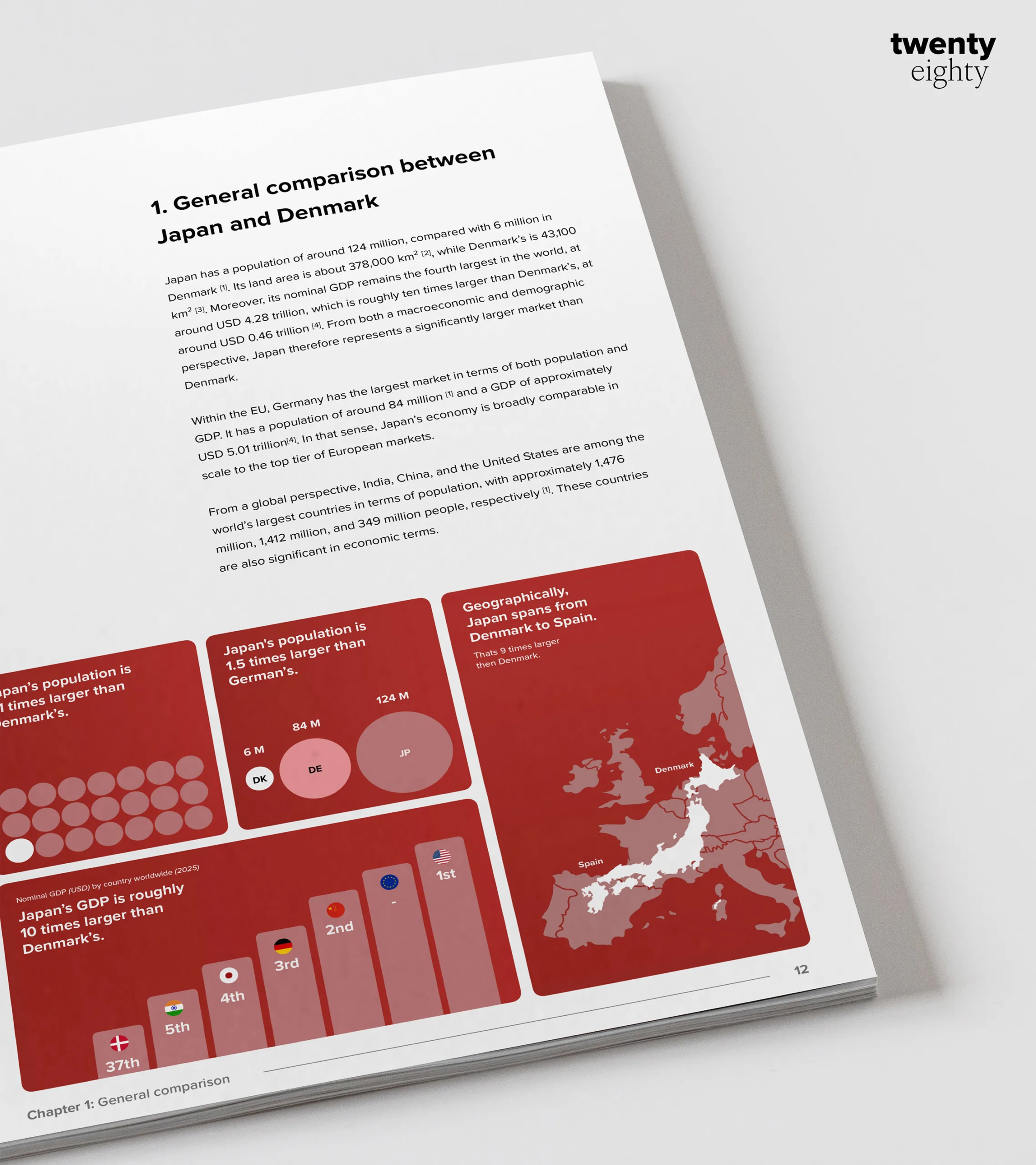
Japan’s population is 21 times larger than Denmark’s.

Denmark

The Shibuya crossing in Tokyo from above, full of people
A five-storey pagoda, lit at night

Geographically, Japan spans from Denmark to Spain.

9× the size of Denmarkthe size of Denmark

GDP of Japan

$4.3 trilliontrillion

The fourth-largest economy in the world, leading in technology and manufacturing.

Sources: Statistics of Tokyo, 2026; World Bank; Ministry of Foreign Affairs of Japan and of Denmark; International Monetary Fund, 2025.

About the chapter

Japan is one of the world’s most sophisticated consumer markets, yet for many Danish companies it remains a market of interest rather than action, often perceived as complex and difficult to access.

The challenge is not only practical. Social and cultural differences shape how decisions are made, relationships are built and value is perceived. Understanding these conditions is therefore essential to assessing whether Japan is strategically relevant and how companies can approach the market effectively.

This chapter provides a high-level introduction to Japan as both a country and a market, covering demographics, politics, education, healthcare, and the broader social and cultural context. Together, these factors provide a foundation for understanding the structures and values that shape long-term decision-making in Japan.

Get the guide

Get the guide.

Chapters one and two, sent to your inbox. See Japan more clearly.

We’ll email you the guide, and new chapters as they’re released. You can unsubscribe at any time.

A printed page from chapter one: a general comparison between Japan and Denmark

Highlights from the chapter

Japan is not a market that can be understood through scale or opportunity alone. Its regional differences, preference for harmony, and ongoing social and economic changes all shape how companies need to interpret the market and build relationships within it.

For Danish companies, the challenge is both external and internal. Success depends not only on understanding how Japan works, but also on being clear about what your own company represents, how that value is perceived in a Japanese context, and where it can become meaningful.

We therefore propose three connected movements for companies considering opportunities in the Japanese market:

  1. 01UnderstandShould Japan be part of your strategic direction?
  2. 02TranslateWhat position can you credibly play?
  3. 03ConnectWith whom can you create value together?

Together, they provide a practical framework for assessing whether Japan fits your strategic direction, defining a credible position in the market, and building the partnerships needed to create long-term value.